

Bond yields 2026 at a 24-year high
Most people never look at the bond market. They don’t need to, because the bond market has a habit of showing up on its own: in the mortgage offer, the credit card statement, the savings account rate and the value of a pension. This month it showed up loudly.
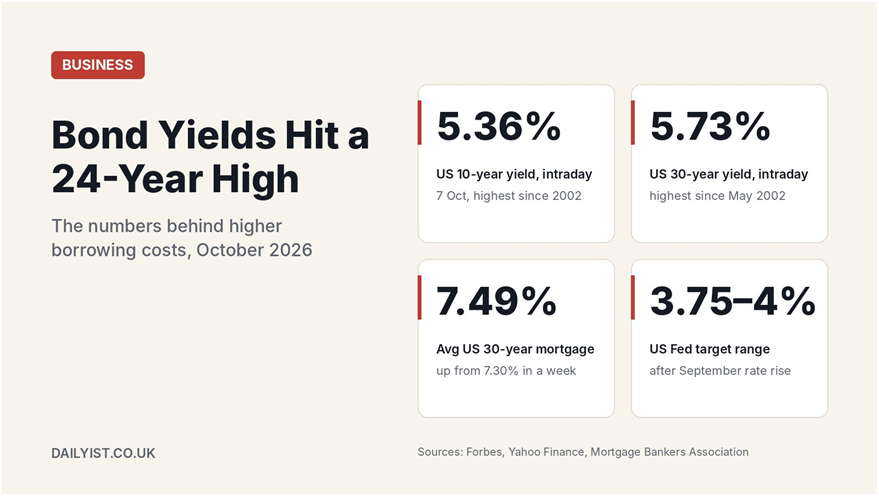
On 7 October, the yield on the US 10-year Treasury bond climbed above 5.35% during trading, its highest level since 2002, according to Forbes. The 30-year bond touched 5.73%. And this is not only an American story. UK gilt yields have hit their highest level since 2008, and Japan’s 10-year yield reached a three-decade high.
Here is what is going on, in plain English, and why it reaches your wallet even if you have never bought a bond in your life.
First, what is a bond yield?
When a government needs money, it borrows by selling bonds. The yield is the return investors demand for lending to it. If investors get nervous about inflation, debt or the future in general, they ask for more, and yields rise.
The 10-year US yield matters because it acts as the world’s benchmark interest rate. Banks, mortgage lenders and companies price their own loans off it. When it goes up, borrowing gets more expensive almost everywhere.
Five things pushing yields up at once
What makes this moment unusual is not one big shock. It is several medium-sized pressures landing together.
1. Energy is driving inflation again. US consumer prices rose 3.4% in the year to August. Energy alone was up 16.3% and petrol 27.4%, as the conflict involving Iran knocked refining capacity offline. Brent crude has been trading around $100 a barrel, with attacks near the Strait of Hormuz adding to supply fears, according to Yahoo Finance.
2. The Fed is raising rates, not cutting them. On 16 September, the US Federal Reserve raised its benchmark rate by a quarter point to 3.75%–4%. Minutes released on 7 October showed most officials expect another rise “would likely be appropriate by year end.” A year ago, markets were betting on cuts.
3. Governments are borrowing heavily. The US Congressional Budget Office projects a $1.9 trillion deficit for fiscal 2026, around 5.8% of GDP, with interest costs alone above $1 trillion. More bonds for sale means buyers can demand a better price.
4. AI companies are borrowing too. This one is new. Goldman Sachs estimates AI-related bond sales at $489 billion so far this year, already more than all of 2025. Tech giants funding data centres now compete with governments for the same long-term investors.
5. Everyone else’s yields are rising. When gilts, Japanese bonds and French bonds pay more, US Treasuries look less attractive by comparison, and their yields have to rise to keep up.
There is a technical detail that tells you a lot. The yield on inflation-protected US bonds has risen from 1.90% to 2.94% this year. That means investors are not only worried about inflation. They want more reward simply for lending money for ten years. That is a deeper shift in mood.
What it means for mortgages
This is where most households feel it first. In the US, the average 30-year fixed mortgage rate jumped from 7.30% to 7.49% in a single week, according to the Mortgage Bankers Association.
In the UK the link runs mainly through swap rates, which lenders use to price fixed-rate deals and which tend to move with gilt yields. When gilts climb to levels not seen since 2008, fixed mortgage pricing usually follows within weeks. If you are coming off a fix in the next six months, now is the time to speak to a broker and look at locking in an offer early. Many lenders let you secure a rate up to six months ahead.
What it means for savers
There is a silver lining. Higher yields usually mean better rates on savings accounts, fixed-term bonds and annuities. People approaching retirement can lock in annuity incomes that would have seemed impossible five years ago. Cash savers should check whether their bank is passing on the higher rates, because many are slow to do so.
What it means for shares and pensions
Stocks have so far held up well. The S&P 500 closed at a record high on 6 October before slipping 0.22% the next day. But high yields are a headwind for share prices, especially for fast-growing tech companies whose value depends on profits far in the future.
There is also a concentration problem. Nvidia, Apple and Microsoft together make up roughly a fifth of the S&P 500. If rising rates hit tech, global index funds and many workplace pensions feel it more than they did in past cycles.
Could yields come back down?
Yes, and there are clear triggers to watch.
- A ceasefire or oil deal involving Iran would ease energy prices and inflation expectations quickly.
- Softer core inflation. Prices outside food and energy are running at just 2.4%, which could let the Fed stop after one or two more hikes.
- Bargain hunters. At nearly 6% on 30-year bonds, pension funds and insurers may step in to buy, which would pull yields lower.
On the other side, deficits are still growing and the AI spending wave shows no sign of slowing. Some analysts, including UBS, argue that 5% yields may be a new normal rather than a spike.
Dates to watch
- 14 October: US inflation figures for September
- 27–28 October: Federal Reserve meeting
- Early November: US Treasury announces how much it plans to borrow next quarter
The bottom line
For most of the past fifteen years, money was cheap and borrowers had the upper hand. That era is clearly over. A 24-year high in the world’s most important interest rate is a signal that the cost of money is resetting, and it rarely stays in the bond market for long.
You don’t need to trade bonds to respond. Review your mortgage timing, make your savings work harder, and check how heavily your pension leans on a handful of tech stocks. Those three steps matter more this autumn than any market headline.
This article is for general information and is not financial advice.
Sources: Forbes, Yahoo Finance.





Leave a Reply